
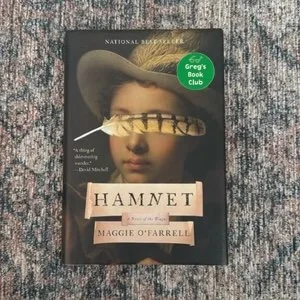
Greg’s Guide to
Hamnet
by Maggie O’Farrell
Framing the Novel
A story less about Shakespeare the legend and more about the fragile, universal bonds of family, grief, and memory.
Greg’s Notes
Inspired by a detail in the notoriously vague biographical record of William Shakespeare—the death of his 11-year-old son Hamnet four years before the London production of his play Hamlet—Scottish author Maggie O’Farrell has written an achingly beautiful historical novel about an unconventional family that dares to think and behave against the norm, the terrible grief that threatens to tear them apart, and the amazing ways those that remain discover a way to transcend such deep and heavy sorrow.
Throughout the novel, the author never names the male figure at the center of the novel—no mention of “Shakespeare,” no “William” and no “Will.” The character derived from the actual figure of the Bard is called “the Latin tutor,” the “husband” or the “father.” Other characters, including his wife Agnes, his children Susanna, Hamnet and Judith, are all specifically identified.
Points to Ponder
What is this author up to by deliberately obscuring Shakespeare’s name in a novel about this historical figure’s early marriage, his move from the country to London to begin writing plays and the death of his only son?
Are we meant to focus on the more universal emotions and experiences of the characters rather than the historical and/or biographical implications and contexts?
If not a novel about Shakespeare’s creative development and process, what is the thematic focus of O’Farrell’s narrative?
Agnes as Outsider
Agnes lives at the edge of her world—guided by instinct and wild wisdom in a society that fears what it cannot explain.
Greg’s Notes
Agnes, the female protagonist of HAMNET and wife of the playwright, is a free-spirited gifted herbalist who grew up “on the edge of the forest” and is able to communicate with falcons and squirrels. Her mother—now dead—introduced her to the sylvan life, emerging, according to village folklore, out of the woods to teach Agnes the mysteries of nature. It is said that Agnes can see through a thin veil that separates the present and the future. She has a habit of pinching the flesh between the thumb and the forefinger in order to see the mysteries hidden inside another:
“[Agnes] grows up fascinated by the hands of others, drawn always to touch them, to feel them in hers. That muscle between thumb and forefinger is, to her, irresistible. It can be shut and opened like the beak of a bird and all the strength of the grip can be found there, all the power of the grasp. A person’s ability, their reach, their essence can be gleaned. All that they have held, kept, and all they long to grip is there in that place. It is possible, she realises, to find out everything you need to know about a person just by pressing it.”
Agnes, the female protagonist of HAMNET and wife of the playwright, is a free-spirited gifted herbalist who grew up “on the edge of the forest” and is able to communicate with falcons and squirrels. Her mother—now dead—introduced her to the sylvan life, emerging, according to village folklore, out of the woods to teach Agnes the mysteries of nature. It is said that Agnes can see through a thin veil that separates the present and the future. She has a habit of pinching the flesh between the thumb and the forefinger in order to see the mysteries hidden inside another:
“… feeling wrong, out of place, too dark, too tall, too unruly, too opinionated, too silent, too strange. She grows up with the awareness that she is merely tolerated, an irritant, useless, that she does not deserve love, that she will need to change herself substantially, crush herself down if she is to be married. She grows up, too, with the memory of what it meant to be properly loved, for what you are, not what you ought to be.”
Points to Ponder
How does Agnes represent an alternative way of thinking—and being—than those who surround her in her step-family, her family by marriage and her country hometown?
How does her point of view, her perspectives and her behavior work against the people in the world around her, who are more worried about appearances, about proper ways of making a living, about dowries, and about reputation?
Why does the glovemaker’s son, who cares more about Latin words than the family business, appeal to Agnes?